

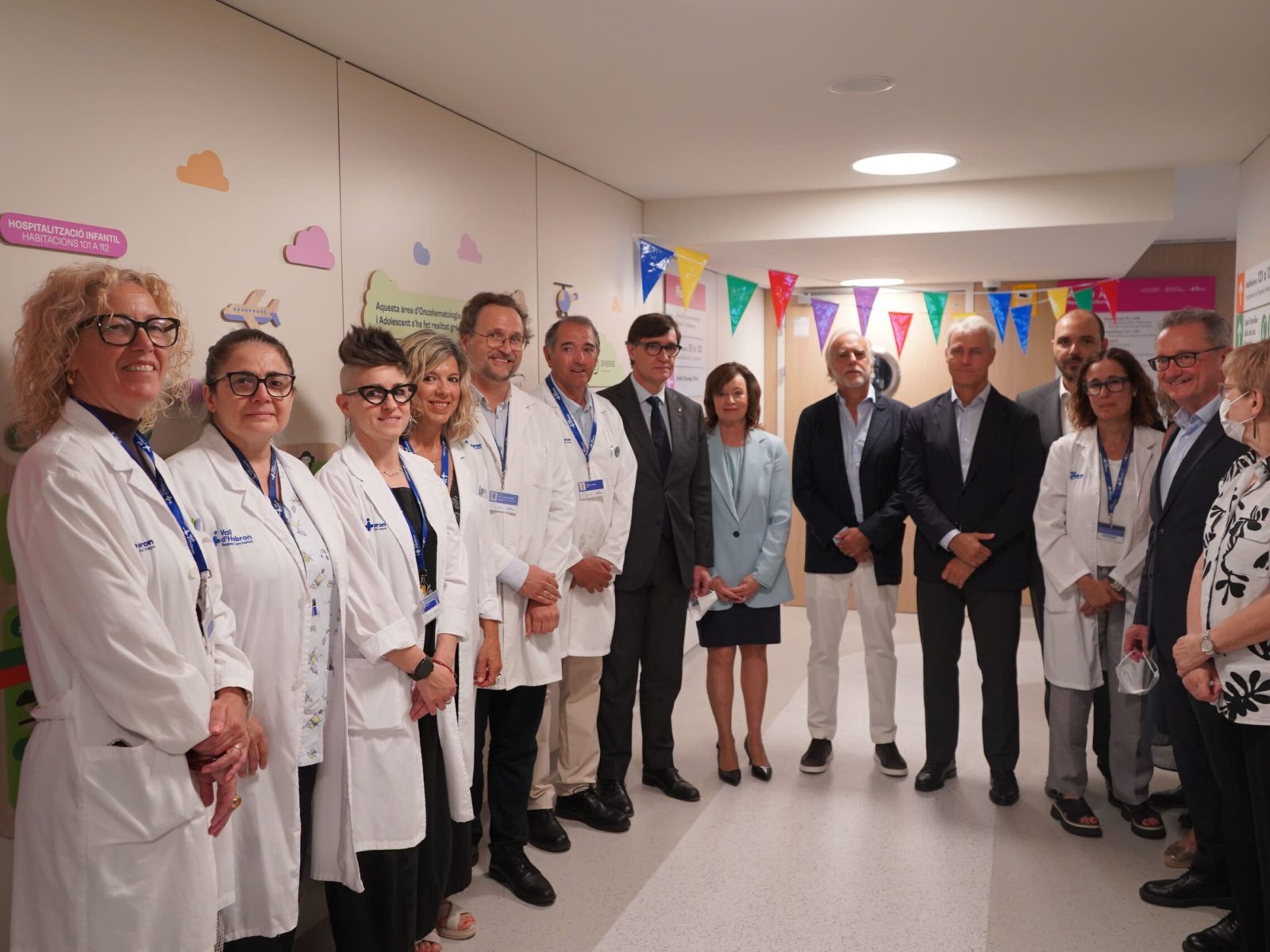
- The President of the Generalitat, Salvador Illa, opens the new Paediatric and Adolescent Onco-haematology Area, which has twelve individual rooms for children, eight for adolescents and young adults, and nine protected-environment rooms for haematopoietic transplantation
- Fundación Aladina, Fundació Albert Bosch and Fundación Small have fully funded the renovation of the new Paediatric and Adolescent Onco-haematology Area, which, with a cost of 7.4 million euros, doubles the previous surface area, with 2,646 m², and improves the emotional well-being of patients
- Its design is the result of a co-creation process involving patients, families and professionals, so that the new area responds to the needs of patients and companions, incorporating an outdoor terrace and shared leisure and rest spaces
The President of the Generalitat, Salvador Illa, today opened the new Paediatric and Adolescent Onco-haematology Area at Vall d’Hebron University Hospital, which is now a reality. The project has been fully funded by Fundación Aladina, Fundació Albert Bosch and Fundación Small, with a cost of 7.4 million euros. President Salvador Illa highlighted the value of the new facilities, especially the fact that they “turn a medical hospital space into almost a home”. President Illa took advantage of his visit to Vall d’Hebron Hospital to underline “the importance of having cutting-edge, universal, top-level healthcare, as one of the factors that most unites Catalan and Spanish society”.
President Illa toured the facilities, which cover more than 2,646 m² and double the previous space dedicated to these patients, accompanied by Dr Albert Salazar, manager of Vall d’Hebron University Hospital; Dr Lucas Moreno, head of the Paediatric Oncology and Haematology Department at Vall d’Hebron University Hospital; Laura Gallego, nursing supervisor of Paediatric Oncology and Haematology at Vall d’Hebron University Hospital; Paco Arango, president of Aladina; Anna Bosch, president of Fundació Albert Bosch; and Laura Lucaya, vice-president of Fundación Small.
The new Paediatric and Adolescent Onco-haematology Area at Vall d’Hebron University Hospital brings together twelve rooms for children, eight for adolescents and young adults, and nine protected-environment rooms for haematopoietic transplantation, all individual and designed as small apartments to encourage family life. It also has an outdoor terrace on the same level as the ward so that children and adolescents can enjoy fresh air whenever their clinical condition allows, leisure and rest areas differentiated by age group, shared spaces for their families and larger work areas for professionals with better lighting conditions. “The new Paediatric and Adolescent Onco-haematology Area is a fundamental part of the New Vall d’Hebron and exemplifies how public-private collaboration allows us to move forward in the treatment and care of patients, as well as improving their emotional well-being”, explains Dr Albert Salazar, manager of Vall d’Hebron University Hospital.
The renovation has involved a total investment of 7.4 million euros between construction work and clinical equipment, and its design was co-created by patients, families and professionals to guarantee a functional space that responds to users’ needs. “The renovation of the Paediatric and Adolescent Onco-haematology Area has given us the opportunity to rethink the space and bring it up to the level of an international oncology centre of reference such as Vall d’Hebron”, explains Dr Lucas Moreno, head of the Paediatric Oncology and Haematology Department at Vall d’Hebron: “from now on, patients will have individual, bright and comfortable rooms; professionals will have more efficient workspaces, and we have changed the paradigm for admitting patients who need a haematopoietic progenitor transplant: the former isolation rooms have been replaced by protected-environment rooms, more accessible to families but with strict infection control”, he adds. The shared areas include a family space equipped with tables, a sofa and brunch area, a therapeutic rehabilitation area, a playroom differentiated for children and adolescents or young adults, a hospital classroom where they can continue their education while admitted, and a psycho-oncology office.
Personalised care for paediatric and adolescent patients
Paediatric patients, adolescents and young adults have rooms in separate areas and differentiated play and recreation rooms. In the case of children, the room is located opposite the family space. This room is arranged into areas adapted to the different developmental stages of childhood, making it possible to carry out various guided activities and free play. The games are organised by age and a mat area has been set up to encourage crawling, which is essential for the motor development of the youngest children within the hospital environment. This playroom leads to a 240 m² outdoor terrace with views of Collserola, accessible only to patients and their families, equipped with seating, table football and other games, so that patients can enjoy the fresh air whenever their condition allows.
The adolescents’ playroom has poufs, tables with sockets, a cinema screen, a recreation room where they can record videos and audio, and a room with blackboard walls that invites privacy and reflection, where they can write down their thoughts to let off steam. “We have clearly differentiated the areas dedicated to adolescent and young adult patients, both in the rooms and in the leisure spaces. Encouraging patients to interact with other people of their own age who are going through similar circumstances and carrying out activities designed for them supports socialisation, their maturational development and emotional well-being, which is so important for ensuring adherence to treatment and improving their prognosis”, explains Elena Nogales, nursing supervisor of the Paediatric Oncology and Haematology Department at Vall d’Hebron.
The new Paediatric and Adolescent Onco-haematology Area combines comfort with the most innovative technology, with medical equipment for semi-critical patients, representing an important qualitative and safety leap that will facilitate the development of more complex innovative therapies. The rooms feature materials that imitate wood and soft, warm tones, as well as glass to enhance brightness, and ceiling neon lights that change colour with drawings of clouds and aeroplanes, along with wall decoration inspired by Japan for adolescents and China for the paediatric rooms. All patient information generated by medical devices, as well as images from the cameras installed in the rooms, are transferred to the Control Area located in the central part, to facilitate continuous patient monitoring and decision-making while prioritising the rest of patients and families.
The new area has a Clinical Trials Unit, with equipment to carry out the 60 active clinical trials at Vall d’Hebron in research lines such as advanced therapies and CAR-T, gene therapy and neuroblastoma. The Paediatric Oncology and Haematology Department at Vall d’Hebron University Hospital is an accredited centre of excellence and a national and international reference in progenitor transplantation, complex surgeries, radiotherapy, non-malignant haematological diseases, sarcomas and neuroblastomas, and treats around one hundred new patients a year, as well as between 30 and 40 patients who come from all over the country to undergo complex procedures such as surgery, haematopoietic progenitor transplantation and clinical trials. All these children and adolescents with onco-haematological diseases will benefit from the comprehensive renovation of the new space.
Since the opening of the new area, it has recorded more than 400 admissions and a total of 72 Haematopoietic Progenitor Transplants (TPH) and CAR-T therapies have been carried out. The average length of stay in the Paediatric and Adolescent Onco-haematology Area is ten days. In the field of research, Vall d’Hebron has 51 open clinical trials, 24 of them in phase 1, and recruits 40 patients every year, who can benefit therapeutically from the open lines of research.
According to Paco Arango, president of Aladina, “today is a deeply emotional day; it means much more than opening a space: it means offering light, hope and a more human environment to children and families who are going through one of the most difficult moments of their lives. I want to thank Fundació Albert Bosch and Fundación Small from the bottom of my heart for walking alongside us in this very important adventure. When several foundations join forces while always placing the child at the centre, extraordinary things happen”. For Aladina, this project represents its first major step in Catalonia: “It has taken many years of effort, excitement and joint work to transform a hospital into a place that is a little kinder, warmer and more human”, adds Paco Arango.
“At Fundació Albert Bosch we always say that childhood cancer should not exist, and it is this deep conviction that drives our commitment to projects that aim to transform the reality of children and adolescents with cancer”, explains Anna Bosch, president of Fundació Albert Bosch: “We wanted to help change the way patients, families and professionals experience and relate to the hospital environment, with a more human, welcoming space designed around their needs. This project is also proof that, when we join forces, we are capable of generating a real and lasting impact on the lives of many people”. For her part, Laura Lucaya, vice-president of Fundación Small, explains that “the new Paediatric and Adolescent Onco-haematology Area is a dream come true after feeling the need to help improve, as much as possible, the infrastructure of an already excellent oncology service and thus give back part of the care and affection we received when our son overcame an oncological disease 19 years ago”.
This new area would not have been possible without the fundamental support of Fundacio Diverse, Fundació Nemesio Díez, Fundacion la Caixa, Fundació Vila Casas, Fertinagro Biotech, Noel Alimentaria and the Diputació de Barcelona.
As well as the collaboration of Fundació Josep Carreras, Fundació Mir-Puig, Fundació Privada Mar, Diputació de Girona, Rotary Olot-Garrotxa, Diputació de Tarragona, Fundació Probitas, Fundació Mutual Mèdica, Fundació FC Barcelona, T-Systems, Mango, Fundació Aon, Manxa 1876, Fundació Oak House, Fundació Juan Ribas Araquistain, JB Embalatge Group and Associació Mariona.
To all of them we must add the joint effort of civil society, which through donations and the purchase of Realitat Millorada glasses has made it possible for the new Paediatric Oncology Area at Vall d’Hebron to finally become a reality.